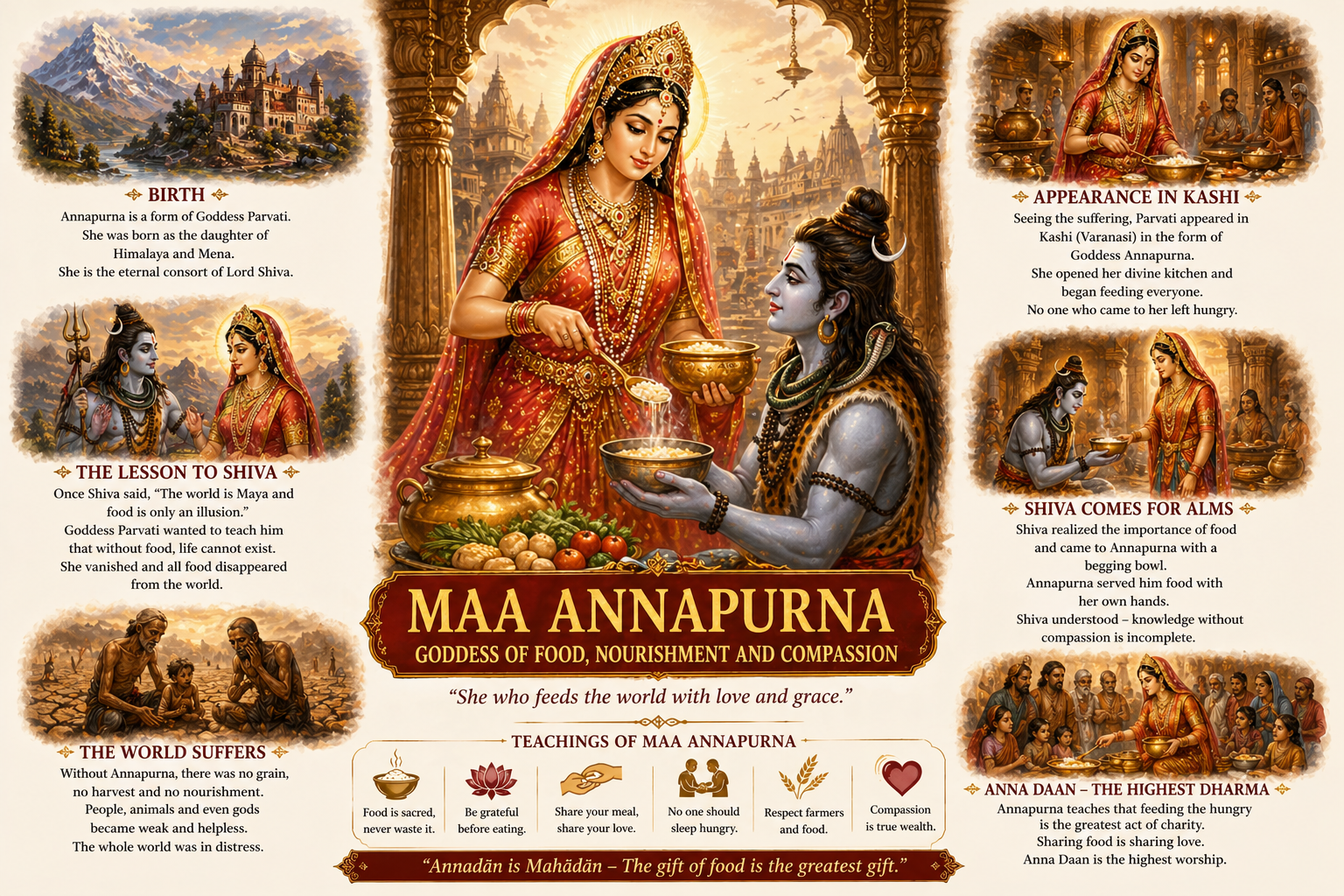
The Story of Goddess Annapurna
(Based on Skanda Purana, Annapurna Upakhyana, Shiva Purana, and Devi Bhagavata Purana)
Who is Goddess Annapurna?
Goddess Annapurna is the goddess of:
Food
Nourishment
Compassion
Motherly care
Abundance
Hospitality
Divine grace
She is a form of Goddess Parvati, the divine consort of Lord Shiva.
She is lovingly called:
👉 Annapurna Devi
👉 Annapoorna
👉 Mata Annapurna
👉 Anna-Datri (The Giver of Food)
She is worshipped as the mother who feeds the world.
She represents not only food for the body, but also:
👉 kindness, sharing, and nourishment for the soul.
Meaning of the Name “Annapurna”
The word Annapurna comes from two Sanskrit words:
👉 Anna = food or grain
👉 Purna = full, complete, perfect
So Annapurna means:
👉 “She who is full of food”
👉 “She who nourishes everyone completely”
She teaches that food is sacred and should never be wasted.
In Hindu tradition, food is considered:
👉 Prasada — a divine blessing from God.
The Story of Shiva and Annapurna
One of the most famous stories of Goddess Annapurna is found in the Skanda Purana.
What happened?
One day, Lord Shiva said:
👉 “The world is Maya (illusion), and even food is only an illusion.”
Goddess Parvati heard this and became serious.
She wanted to teach Shiva an important truth:
👉 Without food, life itself cannot continue.
If food were only illusion, how could anyone survive?
To show this lesson, Parvati disappeared from the world.
And with her disappearance—
👉 all food vanished.
Soon:
The earth became dry
People became hungry
Animals suffered
Even the gods felt weak
There was no grain, no harvest, no nourishment.
The whole world faced great suffering.
Goddess Appears in Kashi
Seeing the suffering of the world, Parvati appeared in:
👉 Kashi (Varanasi)
There she took the beautiful form of:
👉 Goddess Annapurna
She opened a divine kitchen and began feeding everyone.
Rich and poor
Saints and kings
Children and old people
Humans and divine beings
Everyone received food equally.
Because for Annapurna:
👉 feeding the hungry is the highest worship.
She became the mother of all.
Shiva Comes for Alms
Lord Shiva saw that the world depended on food and nourishment.
He understood his mistake.
He came to Goddess Annapurna with a begging bowl.
Yes—
👉 even Lord Shiva stood before her for food.
Annapurna lovingly served food to Shiva with her own hands.
This teaches:
👉 knowledge without compassion is incomplete.
👉 spirituality without service is not complete.
Even the greatest wisdom must respect the importance of food and care.
Annapurna and the Golden Bowl
In many temples, Annapurna is shown holding:
A golden bowl full of food
A ladle for serving
A calm and loving smile
Why?
Because she teaches:
👉 Giving food is one of the greatest forms of charity.
This is called:
👉 Anna Daan (Donation of Food)
In Hindu tradition, Anna Daan is considered one of the highest acts of Dharma.
Because food saves life directly.
Annapurna and Kashi Vishwanath
Goddess Annapurna is especially worshipped in:
👉 Kashi (Varanasi)
Near the famous temple of Lord Shiva:
👉 Kashi Vishwanath
There stands the sacred temple of:
👉 Maa Annapurna
Devotees believe:
👉 No one who comes to Annapurna with faith leaves hungry.
She blesses people with both:
food for the body
wisdom for the spirit
Lessons from Goddess Annapurna
She teaches that:
Food is sacred
Sharing is divine
No one should sleep hungry
Feeding others is true worship
Humility is greater than pride
She reminds us:
👉 Never disrespect food.
👉 Always be grateful before eating.
👉 Share your meal whenever possible.
Even a small act of kindness can become a great blessing.
Why Goddess Annapurna is Remembered
She feeds the entire universe like a mother
She teaches that compassion is greater than pride
She reminds us that food is divine
She blesses homes with abundance and peace
She shows that true wealth is the ability to nourish others
She is not only the goddess of food—
👉 She is the goddess of care, love, and selfless giving.
📖 Moral for Kids
👉 “Food is sacred—never waste it.”
👉 “Sharing your meal is sharing love.”
👉 “Helping the hungry is one of the greatest good deeds.”
👉 “True richness is not having more, but giving more.”
👉 “A kind heart feeds both body and soul.”