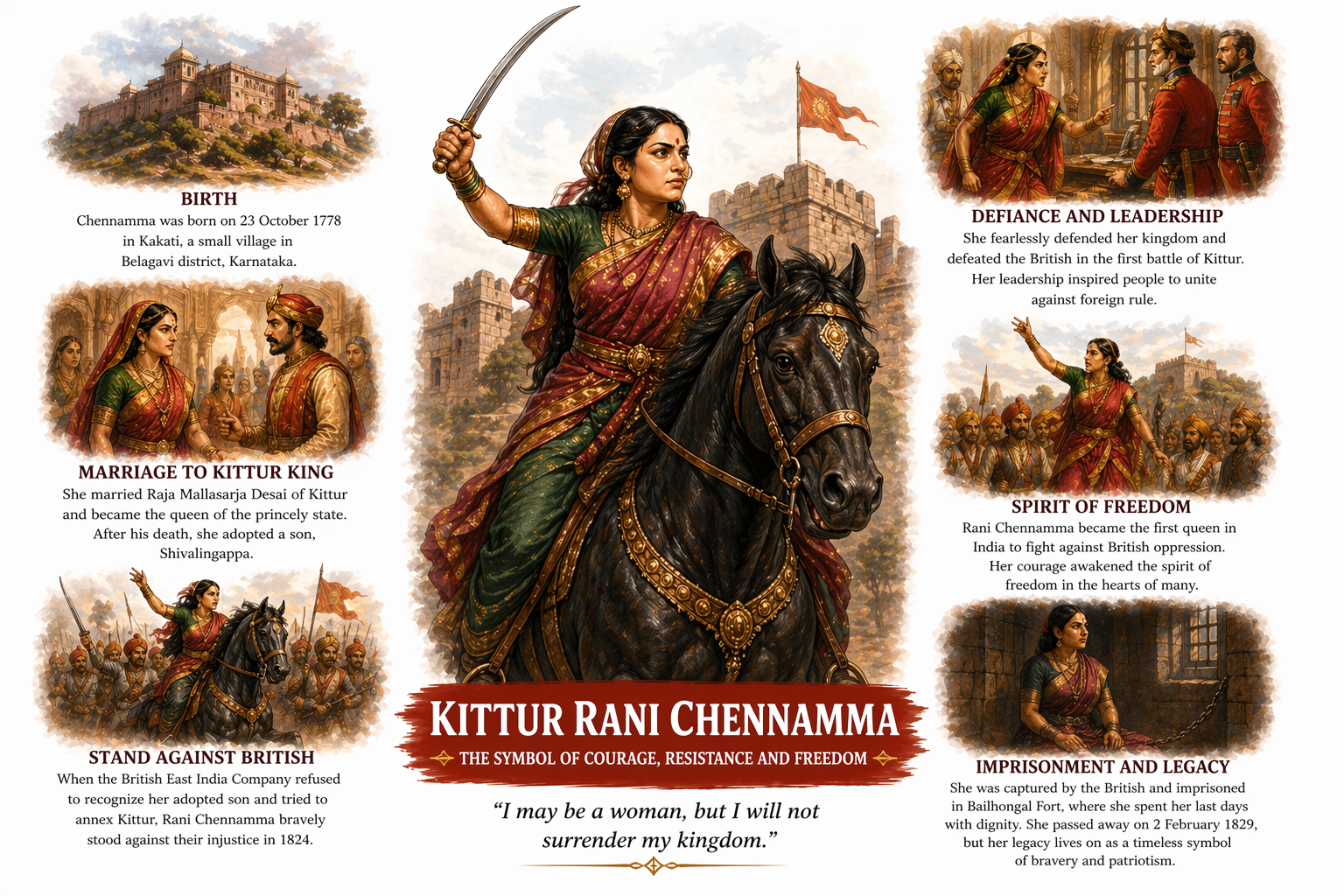
The Story of Kittur Rani Chennamma
Early Life (1778–1793)
In 1778, in a small village called Kakati, a brave girl was born. Her name was Chennamma.
From a young age, she was not like other children. She was:
Bold and fearless 💪
Intelligent and quick learner 🧠
Skilled in horse riding 🐎 and sword fighting ⚔️
She was trained in:
Archery
Warfare skills
Statecraft
Even as a child, she showed signs of becoming a great leader.
Becoming the Queen of Kittur
Chennamma was married to Mallasarja Desai, the ruler of
Kittur.
After marriage, she became Rani Chennamma, the queen of Kittur.
She was known among her people for:
Justice
Kindness
Courage
The kingdom of Kittur was small but prosperous and peaceful.
Tragedy Strikes
Rani Chennamma faced great personal loss:
Her husband passed away
Her only son also died
To continue the royal line, she adopted a boy named Shivalingappa.
She declared him the rightful heir to the throne.
British Interference
At that time, the British East India Company was expanding its power in India.
The British refused to accept the adopted son as king.
They tried to take control of Kittur, similar to what later became known as the
Doctrine of Lapse.
The British demanded that Kittur surrender.
The First War Against the British (1824)
Rani Chennamma refused to bow down.
In 1824, war broke out between Kittur and the British.
Led by officers like St John Thackeray, British forces attacked Kittur.
But Rani Chennamma:
Led her army bravely
Used smart strategies
Inspired her soldiers
In the battle, the British officer Thackeray was killed.
This was one of the first victories of an Indian ruler against the British.
Continued Resistance
Even after this victory, the British sent more troops.
Rani Chennamma continued to fight with courage.
Her loyal commanders, like Sangolli Rayanna, stood by her side.
However, due to betrayal from within and the strength of British forces, the situation became difficult.
Capture and Imprisonment
Eventually, Rani Chennamma was captured by the British.
She was imprisoned in Bailhongal Fort.
Even in prison, she remained strong and fearless.
Death and Sacrifice (1829)
On 21 February 1829, Rani Chennamma passed away in captivity.
But her spirit of resistance did not die.
Legacy of a Brave Queen
Rani Chennamma is remembered as:
One of the first Indian queens to fight British rule
A symbol of courage and independence
A true warrior who stood against injustice
Her struggle came before the Revolt of 1857, making her one of the earliest freedom fighters.
🏆 Why She Inspires Us
She fought for her kingdom’s rights
She refused to accept unfair rules
She showed that courage has no fear
Even today, she is honored in Karnataka and across India.
Moral of the Story
👉 Stand against injustice, be brave, and never give up your rights—even in the face of powerful enemies.